TopX: Text-to-Motion for Unseen Skeletons from the Skeleton File Alone
1University of Southampton 2Nanjing University 3MOGO AI
†Corresponding author
One model, ten skeletons it was never trained on.
Abstract
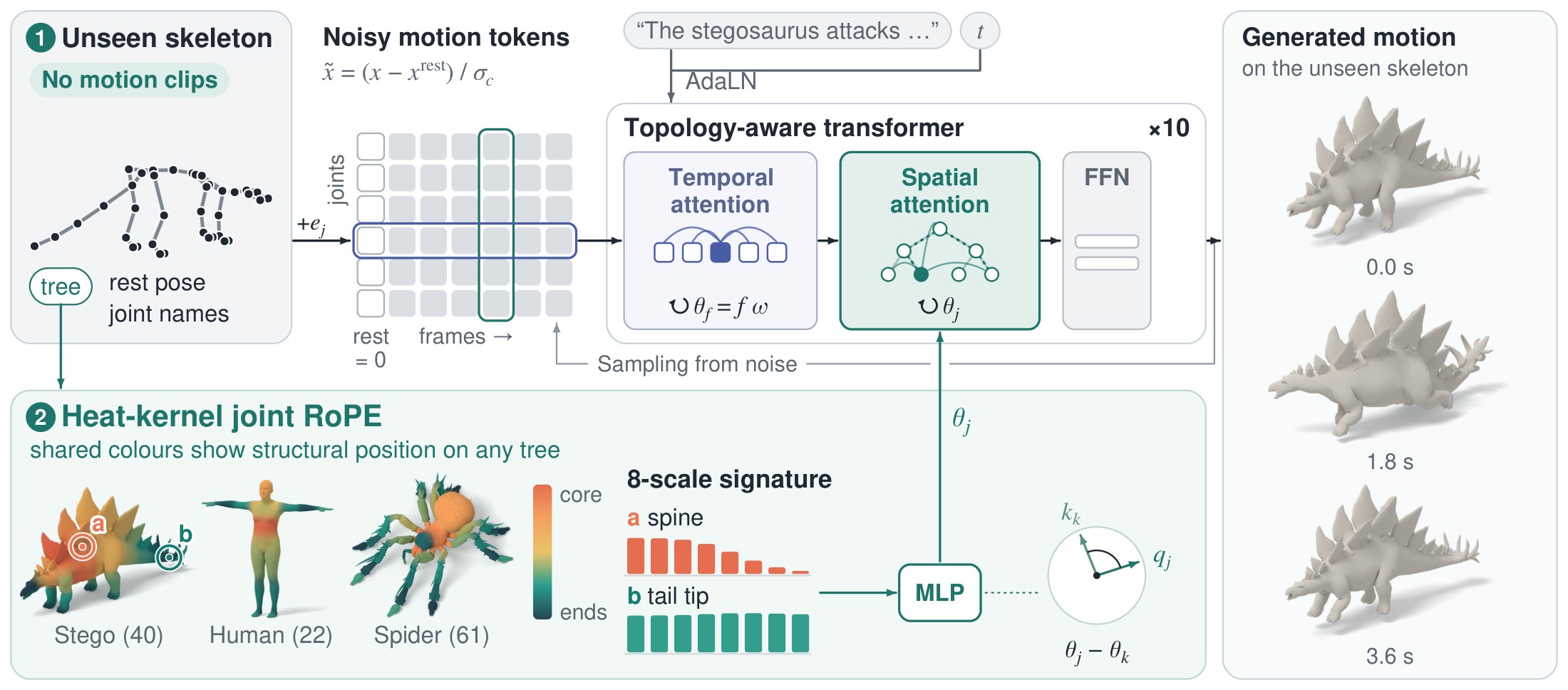
Text-to-motion models generate motion only for the skeletons they were trained on, while a new character arrives as a skeleton file and nothing else. We study text-to-motion for skeletons unseen in training, without clips of the character, templates, retargeting or fine-tuning. We present TopX, a 73M-parameter flow-matching transformer that generates joint rotations and a root trajectory for any skeleton from its kinematic tree, rest pose and joint names. Motion is normalised by the rest pose and the size of the skeleton, and the rest pose is encoded as a world-frame descriptor that is independent of how the rig's author oriented each joint, while rest conventions are randomised during training. Attention is factorised over the joints and the frames of a motion. Across joints, queries and keys are rotated by HK-RoPE, a heat-kernel rotary encoding of the skeleton graph that is defined for every tree and does not change with the order of its joints or the eigenbasis of its Laplacian; across frames, they are rotated by a rotary encoding of frame order.
To evaluate this generalisation, we build SkelShift, which unifies four motion corpora under one codec and holds out whole skeletons, tree classes and species, so that each test bucket isolates one kind of skeleton shift: topology, joint count, body plan, species or rig source. It scores motion quality without a learned evaluator. A single model animates every benchmark skeleton (4–117 joints) directly from its skeleton file and generates up to 240 frames. On held-out game species its motion is about as close to the real clips as two halves of the real clips are to each other (kernel distance 0.127 against 0.124), and text-to-motion retrieval reaches R@1 0.953, compared with 0.929 for real motion.
MethodFactorised attention with HK-RoPE
SkelShiftEach test bucket holds out one kind of skeleton shift
SkelShift unifies the Objaverse-XL subset of UniML3D, the AniMo4D animal library with HumanML3D, further species from the same game library, and the Truebones zoo under one codec: 139,102 training clips on 5,127 rigs with 6 to 142 joints. The test set holds out clips, rigs, classes of isomorphic trees and species.
| Bucket | Source | Unseen at test time | Test clips | Rigs | Joints |
|---|---|---|---|---|---|
| ID-clip | UniML3D | clips of training rigs | 172 | 135 | 10–60 |
| ID-tree | UniML3D | rigs whose tree is seen | 508 | 759 | 6–60 |
| OOD-tree | UniML3D | tree classes (bipeds, quadrupeds) | 320 | 333 | 11–60 |
| OOD-plan | UniML3D | tree classes of rare body plans | 62 | 70 | 5–60 |
| OOD-J>60 (Mixamo) | UniML3D | rigs of one 65-joint humanoid tree | 350 | 250 | 65 |
| OOD-J>60 (other) | UniML3D | rigs above the corpus's joint range | 512 | 464 | 61–117 |
| OOD-J<5 | UniML3D | rigs below that range | 1 | 2 | 4 |
| OOD-species | game | four species, three rigs each | 635 | 12 | 41–66 |
| OOD-new-species | game | rigs of ten untrained species | 47 | 10 | 28–78 |
| OOD-rig | Truebones | eight quadruped rigs | 62 | 8 | 31–49 |
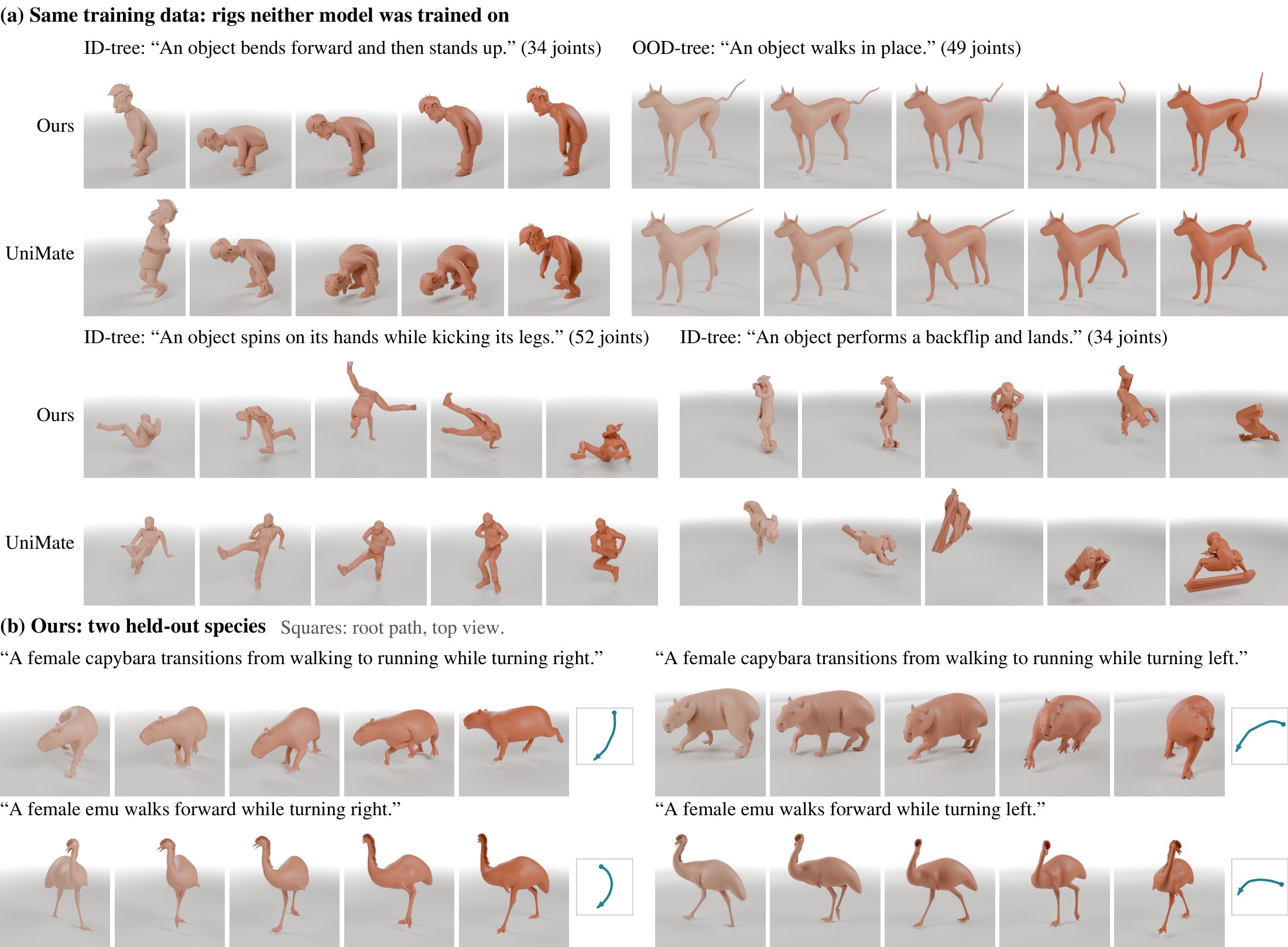
Results on unseen skeletonsWhole outputs, up to 240 frames, played in real time
Stick figures drawn from the generated joint positions, frame by frame, with no smoothing. The large view follows the root joint; the small view below is a fixed camera that shows where the skeleton travels. Clips were chosen by a fixed rule on the real test clips (the most energetic and the longest of each subset), not by looking at generated motion.
“The stegosaurus raises its head slightly and shakes its body from side to side”
“The stegosaurus performs a tail whip by rotating its tail from right to left”
“The cat stretches and yawns, then returns to a sitting position”
“The goat quickly steps back, jumps forward, and mimics a headbutting motion before returning to its original position”
“The turtle prepares and executes an attack by rolling forward”
“A female capybara changes pose, with movement of its head and forelimbs.”
“A spectacled flying fox changes pose, with movement of its forelimbs and head.”
“A danube crested newt changes pose, with movement of its tail and head.”
“An object runs in place and does a handstand.”
“An object dances in place.”
Rendered on the rig's own mesh
BibTeX
@article{sun2026topx,
title = {TopX: Text-to-Motion for Unseen Skeletons from the Skeleton File Alone},
author = {Sun, Tengjiao and Fang, Pengcheng and Zhan, Xiaoyu and Fu, Dongjie and Cai, Xiaohao and Kim, Hansung},
journal = {arXiv preprint arXiv:2610.34321},
year = {2026}
}